Pre-Activation
4.2/5
Google Rated
10+
Years of Experience
ISO 9001:2015
Certified Company
Activation Machinery for Activated Carbon Plant
Micro Fab Engineers manufactures activated carbon plant machinery for converting prepared coconut shell charcoal into activated carbon. The activation process uses a rotary kiln, heat, and steam under controlled operating conditions to develop the pore structure that gives activated carbon its adsorption properties.
Our activation machinery includes a rotary kiln and rotary cooler, with supporting equipment such as a diesel burner and steam supply system incorporated according to the plant configuration. These machines help process prepared charcoal and cool the activated material before it moves to post-activation processing.
Whether you are setting up a new activated carbon manufacturing plant or upgrading an existing facility, Micro Fab Engineers can help you explore suitable machinery based on your production capacity and process requirements.
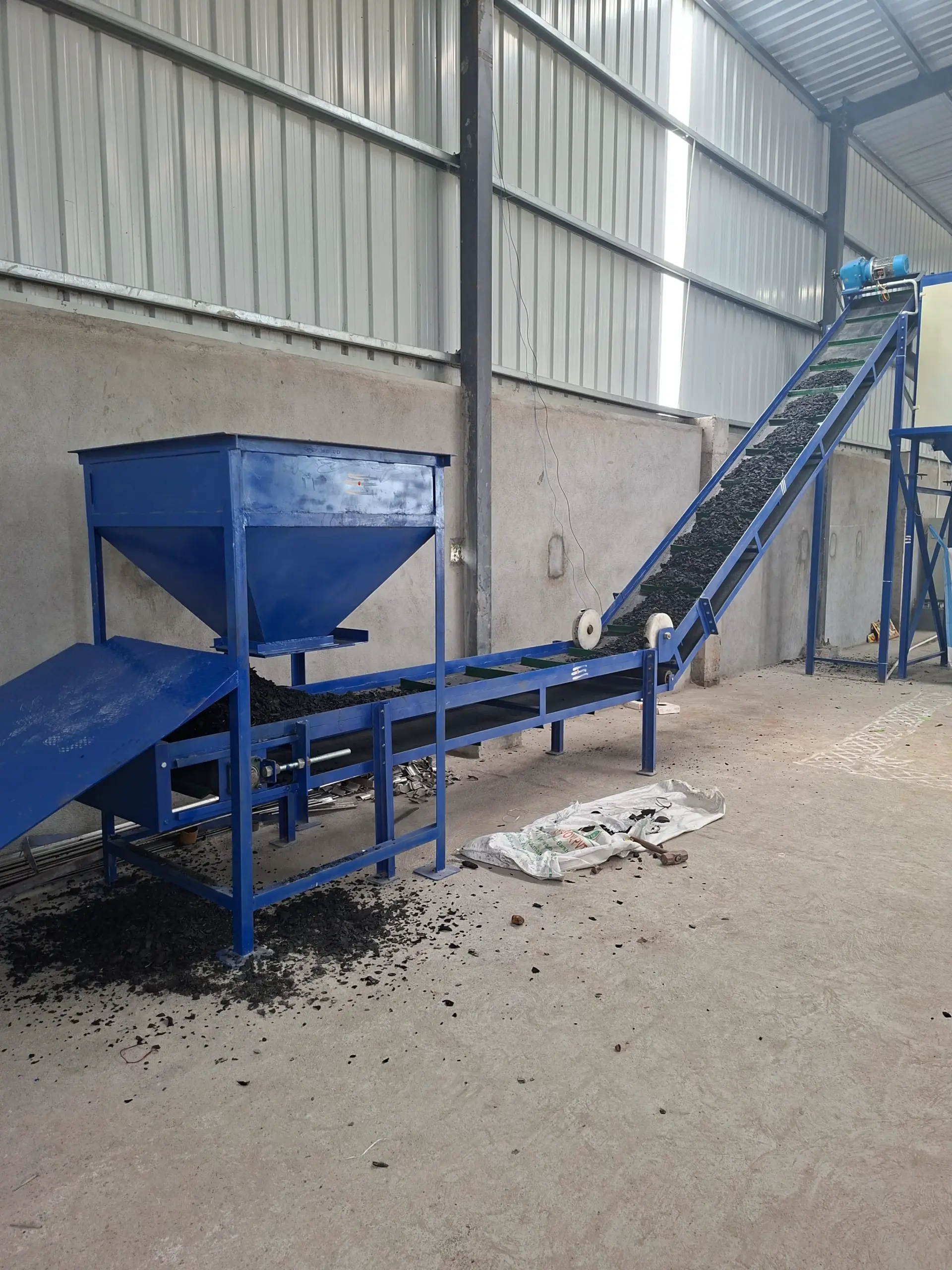
Bucket Elevator
Industrial Bucket Elevator for Coconut Shell Charcoal
The bucket elevator is an essential material-handling machine in coconut shell activated carbon plant machinery. It is designed to lift sized coconut shell charcoal from jumbo bags to the storage bin before the activation process.
Using a continuous bucket lifting mechanism, the machine transports charcoal vertically with minimal manual handling. It ensures an efficient transfer of raw material to the storage section and supports a consistent supply for the subsequent kiln-feeding operation.
The bucket elevator can be configured according to the required lifting height, material-handling capacity, plant layout, and installation requirements.
Function Of Bucket Elevator
- Receives sized coconut shell charcoal from jumbo bags at the feeding point.
- Lifts charcoal vertically using buckets attached to a continuous conveying mechanism.
- Transfers the material to the storage bin through the discharge outlet.
- Maintains a steady supply of charcoal to the activation section.
- Reduces manual material transportation between storage and feeding equipment.
Benefit Of Bucket Elevator
- Efficient Vertical Transportation: Transfers coconut shell charcoal between different equipment levels.
- Reduced Manual Handling: Minimizes labour requirements for lifting and transporting materials.
- Continuous Material Supply: Supports uninterrupted feeding to the storage bin.
- Space-Saving Design: Uses vertical conveying arrangements to optimize floor space.
- Flexible Installation: Can be configured according to plant capacity and layout.
Storage Bin
Industrial Storage Bin for Activated Carbon Plant
The industrial storage bin is designed to temporarily store sized coconut shell charcoal before it enters the rotary kiln activation process. It is an important component of coconut shell activated carbon plant machinery, providing an intermediate storage arrangement between material transportation and controlled kiln feeding.
The storage bin receives charcoal from the bucket elevator and maintains an adequate material supply for the electro vibro feeding controller. Its storage capacity, dimensions, and discharge arrangement can be customized according to production capacity and operational requirements.
Function Of Storage Bin
- Receives sized coconut shell charcoal discharged from the bucket elevator.
- Temporarily stores charcoal before it enters the kiln-feeding system.
- Supplies material to the electro vibro feeding controller through its discharge outlet.
- Maintains material availability for continuous kiln feeding.
- Helps regulate the material supply between the storage and activation sections.
Benefit Of Storage Bin
- Intermediate Material Storage: Provides temporary storage before the activation process.
- Continuous Production Support: Maintains material availability for the kiln-feeding system.
- Controlled Material Supply: Supports a consistent feeding arrangement.
- Reduced Operational Interruptions: Helps minimize feeding delays caused by material handling.
- Customizable Capacity: Can be designed according to plant production requirements.
Electro Vibro Feeding Controller – Second Stage
Electro Vibro Feeding Controller for Rotary Kiln Feeding
The electro vibro feeding controller is a controlled material-feeding system used in coconut shell activated carbon manufacturing plants. It regulates the discharge of sized coconut shell charcoal from the storage bin and supplies it to the rotary kiln feeding arrangement.
Using controlled electromagnetic vibration, the feeder moves charcoal at a regulated rate, helping maintain a consistent material flow into the activation system. Its feeding rate can be adjusted according to the required production capacity and rotary kiln operating conditions.
This equipment plays an important role in maintaining controlled material feeding and coordinating the flow of charcoal into the rotary kiln.
Function Of Electro Vibro Feeding Controller – Second Stage
- Receives sized coconut shell charcoal from the storage bin.
- Controls material discharge through an electromagnetic vibrating mechanism.
- Regulates the charcoal feeding rate according to operational requirements.
- Transfers material towards the kiln feeding arrangement.
- Helps maintain a uniform supply of charcoal into the rotary kiln.
- Allows feeding adjustments based on the required production flow.
Benefit Of Electro Vibro Feeding Controller – Second Stage
- Controlled Material Feeding: Regulates the discharge rate of coconut shell charcoal.
- Uniform Material Flow: Helps maintain consistent feeding into the rotary kiln.
- Adjustable Feeding Rate: Allows operators to control material supply according to process requirements.
- Reduced Material Wastage: Helps prevent uncontrolled material discharge.
- Improved Process Coordination: Supports better synchronization between the storage bin and rotary kiln.
Kiln Feeding Platform – Three Units
Kiln Feeding Platform for Activated Carbon Plant
The kiln feeding platform is a structural installation designed to support the feeding equipment and provide operational access to the kiln-feeding section of a coconut shell activated carbon plant.
Installed around the feeding arrangement, the platform provides a stable working area for operators to monitor material feeding, inspect equipment, and carry out routine maintenance activities.
The activation plant includes three kiln feeding platform units, arranged according to the equipment configuration and plant layout. The platform structure can be designed based on the required height, dimensions, load-bearing requirements, and accessibility.
Function Of Kiln Feeding Platform – Three Units
- Provides structural support for the kiln feeding equipment and associated arrangements.
- Provides access to the feeding section for operators.
- Enables monitoring of charcoal feeding operations.
- Supports inspection and routine maintenance of the feeding equipment.
- Provides an organized working arrangement around the kiln feeding area.
- Integrates with the plant structure according to the equipment layout.
Benefit Of Kiln Feeding Platform – Three Units
- Operational Accessibility: Provides convenient access to the kiln feeding section.
- Equipment Support: Offers a stable structural arrangement for supported equipment.
- Easy Inspection: Facilitates monitoring and inspection of feeding operations.
- Maintenance Convenience: Supports routine equipment maintenance activities.
- Organized Plant Layout: Helps maintain a structured and accessible working environment.
Rotary Kiln
Industrial Rotary Kiln for Coconut Shell Activated Carbon
The rotary kiln is the primary activation equipment in a coconut shell activated carbon manufacturing plant. It is designed to convert sized coconut shell charcoal into activated carbon through controlled high-temperature treatment and steam activation.
The rotary kiln consists of a rotating cylindrical processing drum that facilitates continuous movement of charcoal through the heating zone. During operation, coconut shell charcoal is exposed to controlled thermal conditions while steam generated from an external boiler is introduced into the kiln.
The interaction of steam with heated carbon develops the internal pore structure responsible for the adsorption properties of activated carbon. The operating temperature, steam supply, residence time, and material feeding rate are controlled according to the required product characteristics and process design.
The rotary kiln is designed to support continuous activation and discharge of processed activated carbon towards the roto cooler.
Function Of Rotary Kiln
- Receives sized coconut shell charcoal through the kiln feeding arrangement.
- Rotates the cylindrical drum to facilitate continuous material movement.
- Heats coconut shell charcoal under controlled operating conditions.
- Receives steam generated separately by the external boiler.
- Facilitates the steam-carbon reaction required for the activation process.
- Supports the development of the pore structure and adsorption characteristics of activated carbon.
- Continuously discharges hot activated carbon towards the roto cooler.
Benefit Of Rotary Kiln
- Efficient Steam Activation: Facilitates the activation of coconut shell charcoal using controlled steam supply.
- Continuous Processing: Supports continuous material movement and activation.
- Controlled Heating: Provides a controlled thermal environment for the activation process.
- Improved Pore Development: Supports the development of the porous structure responsible for carbon adsorption.
- Consistent Processing: Helps maintain uniform operating conditions through controlled feeding and process parameters.
- Industrial Production: Suitable for continuous activated carbon manufacturing operations.
Chamber
Industrial Chamber for Activated Carbon Activation System
The industrial chamber is a structural component of the activation system in a coconut shell activated carbon manufacturing plant. It provides the designated enclosure and installation space required for the associated activation equipment.
The chamber is incorporated into the plant design to accommodate the required process arrangement and support the operating environment around the activation section. Its dimensions, construction materials, access points, and structural configuration depend on the rotary kiln arrangement and overall plant design.
The chamber is designed to integrate with the activation system while providing suitable access for equipment inspection and maintenance.
Function Of Chamber
- Provides the designated enclosure for the activation system, as per the plant design.
- Accommodates the required equipment and associated process arrangements.
- Supports the structural and operational configuration of the activation section.
- Provides access arrangements for inspection and maintenance.
- Integrates with the rotary kiln installation according to the engineering layout.
Benefit Of Chamber
- Equipment Integration: Provides an organized arrangement for the activation system.
- Structural Support: Supports the designated equipment installation.
- Operational Accessibility: Allows access for inspection and maintenance.
- Plant Organization: Helps maintain a structured activation section.
- Customizable Design: Can be configured according to the plant layout and equipment requirements.
Boiler – External Steam Generation System
Industrial Boiler for External Steam Generation
The industrial boiler is a separate steam-generation system used to supply the steam required for the activation of coconut shell charcoal. It plays an important supporting role in coconut shell activated carbon manufacturing by providing a controlled steam supply to the rotary kiln.
Unlike the rotary kiln, which performs the actual charcoal activation, the boiler generates steam independently and transfers it through a dedicated steam pipeline to the kiln.
The boiler heats water to generate steam at the required operating pressure and flow rate. Its capacity, fuel arrangement, pressure rating, and steam-generation configuration can be selected according to the steam demand and operating requirements of the activation plant.
Function Of Boiler – External Steam Generation System
- Receives water through the designated boiler water-feeding arrangement.
- Generates steam through controlled heating.
- Supplies steam to the rotary kiln through a dedicated steam pipeline.
- Maintains the required steam supply according to the activation process requirements.
- Supports continuous steam availability during kiln operation.
- Operates separately from the rotary kiln as an external steam-generation unit.
Benefit Of Boiler – External Steam Generation System
- Independent Steam Generation: Generates steam separately without relying on the rotary kiln for steam production.
- Controlled Steam Supply: Supports the required steam flow for the activation process.
- Process Support: Facilitates steam-carbon reactions inside the rotary kiln.
- Operational Flexibility: Allows steam generation to be managed independently.
- Continuous Activation Support: Helps maintain the steam supply required during production.
Roto Cooler
Rotary Roto Cooler for Activated Carbon
The roto cooler is an essential cooling machine in coconut shell activated carbon plant machinery. It is designed to reduce the temperature of hot activated carbon discharged from the rotary kiln before collection and subsequent handling.
The machine consists of a rotating cylindrical cooling drum that facilitates continuous movement of activated carbon during the cooling process. As the material travels through the rotating drum, heat is removed through the cooler’s designed heat-transfer arrangement.
The roto cooler helps bring the activated carbon to a suitable handling temperature before it is discharged into jumbo bags for collection and storage.
Function Of Roto Cooler
- Receives hot activated carbon directly from the rotary kiln discharge.
- Rotates the cooling drum to facilitate continuous movement of activated carbon.
- Reduces the temperature of activated carbon through the designated cooling arrangement.
- Maintains continuous material movement during the cooling operation.
- Discharges cooled activated carbon towards the collection section.
- Prepares the material for collection in jumbo bags.
Benefit Of Roto Cooler
- Efficient Temperature Reduction: Reduces the temperature of activated carbon after kiln activation.
- Continuous Cooling: Supports uninterrupted material movement during cooling.
- Safer Material Handling: Helps bring hot activated carbon to a suitable temperature for collection.
- Improved Production Flow: Connects the activation and material collection sections.
- Organized Material Discharge: Supports efficient transfer of cooled activated carbon to jumbo bags.
Jumbo Bag – Activated Carbon Collection and Storage
Jumbo Bag for Activated Carbon Collection and Storage
Jumbo bags are industrial bulk packaging solutions used to collect and temporarily store cooled activated carbon after the rotary kiln activation and roto cooler operations.
These large-capacity bags are positioned at the discharge section of the roto cooler to receive processed activated carbon. They provide a convenient material collection and handling arrangement, allowing the finished or semi-finished activated carbon to be transferred to subsequent processing stages.
The bag capacity, dimensions, lifting loops, and material specifications can be selected according to the quantity of activated carbon being handled and the plant’s packaging requirements.
Function Of Jumbo Bag – Activated Carbon Collection and Storage
- Receives cooled activated carbon discharged from the roto cooler.
- Collects the processed material in bulk quantities.
- Provides temporary storage before subsequent processing.
- Facilitates material transportation within the manufacturing facility.
- Allows collected activated carbon to be transferred to the next processing stage.
Benefit Of Jumbo Bag – Activated Carbon Collection and Storage
- Bulk Material Collection: Collects activated carbon in large quantities.
- Convenient Storage: Provides temporary storage for processed material.
- Easy Material Transportation: Simplifies internal movement and handling.
- Organized Packaging: Supports systematic collection after the cooling process.
- Flexible Capacity: Available in different capacities according to material-handling requirements.
Explore Our Other Plant Machinery
Micro Fab Engineers offers a range of industrial processing machinery designed to meet diverse manufacturing requirements. Explore our other plant machinery solutions to find the right equipment for your production needs.
01
Built for higher Efficiency
Complete machinery solutions for virgin coconut oil extraction and production.
02
Pure Processing Greater Value
03
Turn Waste into Value
Machinery for processing coconut into desiccated coconut powder.
04
Consistent Quality Output
05
Consistent Quality Output
- Our Clients
Trusted by
Leading Brands
Our machines power the success of leading brands across food, beverage, oil, and coconut-based industries.
Years of Experience
Installations Worldwide
Global
Client Network